I remember sitting in a sterile hospital waiting room thirty years ago, listening to a young man weep because he no longer had the vocabulary to describe his own grief. He wasn’t looking for a sociological lecture; he was looking for a way to exist in a world that seemed to have suddenly become uncomfortably quiet. It is precisely this human ache that gets lost when we treat secularisation and its debates as nothing more than a series of data points or a tidy narrative of institutional decline. We talk about the “death of God” or the “rise of the rational mind” as if these were clinical shifts in a laboratory, rather than a profound, often lonely, reordering of the human heart.
I have no interest in providing you with the polished, academic slogans that attempt to tidy up this mess. Instead, I want to offer something a bit more weathered. I intend to look past the grand theories to find the actual, lived reality of what happens when the old structures fall away. My promise to you is an honest account of where the theory meets the bone, exploring the quiet fractures left behind by a changing world without pretending I have all the answers.
The Rationalization of Society and the Quiet Loss of Meaning

I often think back to the quiet corridors of the hospital where I spent my working years. There is a particular kind of silence that settles when a person realizes that the mechanisms of science, as precise as they are, cannot offer a reason for their suffering. This is the shadow side of what Max Weber called the rationalization of society. We have become masters at explaining how things work—the biological failure, the chemical imbalance, the statistical probability—but in our drive to make the world legible and predictable, we have inadvertently stripped it of its mystery.
We tend to treat this shift as a simple linear progression, a tidy march toward enlightenment, but the sociology of religion suggests something far more fractured. It isn’t just that people are forgetting old prayers; it is that the very structures that once held a community together have been replaced by efficient, hollow systems. We have gained a world that is incredibly functional, yet we find ourselves wandering through a landscape where the old landmarks of meaning have been cleared away to make room for more “rational” developments. It is a very efficient sort of loneliness.
The Secularization Thesis Critique Where the Models Falter
For a long time, the academic consensus felt quite settled, almost tidy. The prevailing secularization thesis suggested a predictable trajectory: as science advanced and bureaucracy deepened, the grip of the sacred would simply slip away, leaving behind a purely functional, disenchanted world. But sitting in the quiet corners of hospital wards, I’ve seen that this model often fails to account for the stubborn persistence of the human spirit. We see desecularisation trends emerging in places where one would least expect them, suggesting that the retreat of institutional religion does not necessarily mean the retreat of the impulse toward the divine.
The flaw in the old models often lies in their refusal to distinguish between the decline of a specific institution and the decline of the human need for ritual. While the sociology of religion has certainly documented the shrinking influence of the pulpit in public policy, it often misses the way faith reconfigures itself in the shadows of modernity. We aren’t witnessing a simple disappearance, but rather a profound, often chaotic renegotiation of how we hold the sacred in a world that no longer provides a single, shared architecture for it.
The Shadow of the Empty Pew
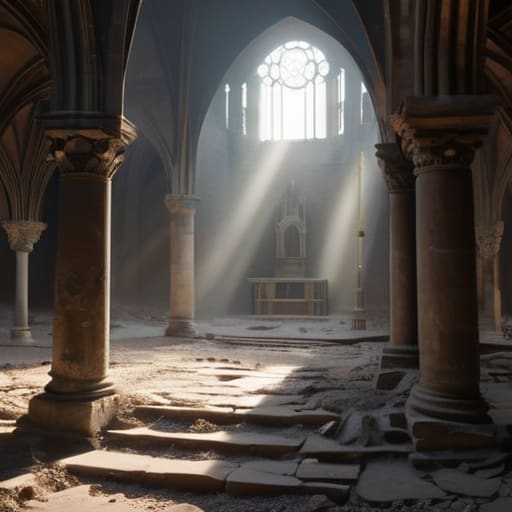
We often mistake the emptying of a cathedral for the disappearance of the sacred, forgetting that while a society might outgrow its rituals, it rarely outgrows its hunger for the transcendent; we are merely trading old, sturdy altars for much thinner, more fragile ways of trying to make sense of the dark.
Alasdair Renwick-Hale
The Unfinished Map
We have seen that secularisation is neither a clean, linear march toward reason nor a simple disappearance of the divine. It is a complicated, often painful reconfiguration of how we find our footing in the world. Between the rationalization of our institutions and the stubborn, messy ways that people continue to seek the sacred in new, unmapped territories, we find that the old models of decline rarely capture the actual lived experience of loss or transition. What we are witnessing is not a vacuum, but a profound, often uncomfortable restructuring of the human search for significance.
As I sit here with my notebooks, I am reminded that we often mistake the changing shape of a vessel for the disappearance of the water within it. The structures of old may be crumbling, but the thirst remains. Perhaps our task is not to mourn the loss of a specific religious architecture, but to learn how to inhabit the quiet, fragmented spaces that remain. We must learn to look more closely at one another, finding meaning not in the certainty of grand doctrines, but in the shared, trembling honesty of our continued striving.