
I remember sitting in a dim hospital corridor during a particularly long night shift, listening to a man try to make sense of his grief through a series of neat, tidy metaphors. He was searching for a way to turn his chaos into a story, desperately hoping that allegory and its history might provide a framework that actually held weight. We are often taught that symbols are these elegant, reliable bridges to the divine or the profound, but in those quiet, heavy hours, I saw how easily they can become crutches for the terrified. We treat the history of symbolism as a grand progression of meaning, yet we rarely admit when the metaphor has simply run out of breath.
I have no interest in giving you a lecture filled with academic jargon or the polished, certainties of a textbook. Instead, I want to look at where these stories actually land in the messy reality of a human life. My aim is to trace the lineage of how we use symbols, not to celebrate their perfection, but to find where they fail us. I offer you an honest account of how we have used imagery to mask the truth, and more importantly, how we might finally use it to encounter it.
Classical Literary Devices and the Illusion of Certainty
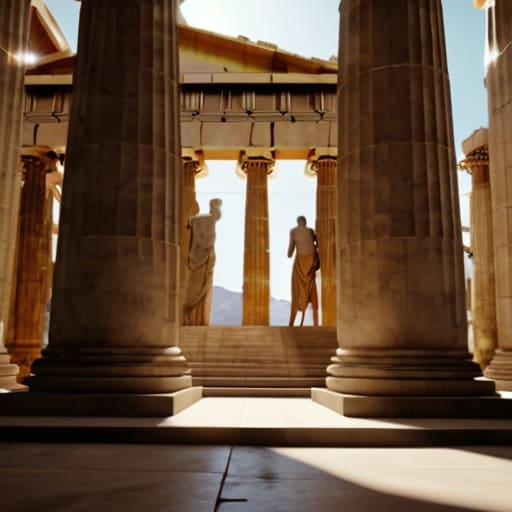
When I look back at the Greeks, I am struck by how they used these tools not just to decorate a story, but to build a scaffold for ideas that were too heavy to stand on their own. We often study classical literary devices as if they were mere ornaments—the lace on a sleeve—but for the ancients, they were more like the structural beams of a cathedral. There is a certain comfort in that kind of clarity; the idea that a character isn’t just a person, but a vessel for a virtue or a vice. It promises a world where everything makes sense if you only look closely enough.
Yet, there is a danger in that comfort. When we lean too heavily on allegorical storytelling techniques, we risk turning the messy, breathing reality of human experience into a series of tidy equations. We start to believe that if we can just decode the symbol, we will have mastered the truth. I have found, much like in the quiet corners of a hospital ward, that the most profound truths often exist in the gaps where the metaphor breaks down and the symbolism in literature fails to capture the actual, unvarnished ache of being alive.
Where Symbolism in Literature Outruns the Authors Intent
There is a certain quiet terror in realizing that once a word is set to paper, it no longer belongs to the hand that wrote it. I have spent many afternoons in my study, looking at my own half-finished manuscripts, and realizing that even the most carefully constructed allegorical storytelling techniques are prone to a kind of slow, beautiful mutiny. An author may intend for a white bird to represent peace, but a reader, perhaps sitting in a hospital room much like the ones I once frequented, might find in that same bird a chilling omen of emptiness.
This is where the mechanics of symbolism in literature begin to fray at the edges. We often mistake the author’s blueprint for the building itself, forgetting that hermeneutics and interpretation are living, breathing processes. A symbol is not a static object; it is a vessel that collects the dust and the light of every person who looks upon it. Eventually, the meaning outruns the intent, leaving the creator to stand by, somewhat helpless, as their work begins to say things they never had the courage to say themselves.
The Fragility of the Hidden Meaning
We often treat the history of allegory as a grand scavenger hunt for a single, hidden truth, but I have found that the most profound symbols are not those that point clearly to a destination, but those that sit quietly with us in the dark, refusing to provide the easy answers we so desperately crave.
Alasdair Renwick-Hale
The Limits of the Map
We have traced the long, winding path of allegory from the rigid structures of the ancients to the more fluid, often unintentional meanings we find in modern prose. We have seen how it can act as a bridge between the finite word and the infinite concept, yet we have also acknowledged its tendency to become a cage—a way of forcing a complex reality into a preordained shape. To rely too heavily on the allegory is to risk mistaking the shadow for the substance, forgetting that the most profound truths often lie in the gaps where the symbol finally breaks under the weight of lived experience.
In my years sitting by hospital beds, I found that people rarely needed a tidy metaphor to explain their suffering; they needed someone to acknowledge the raw, unadorned fact of it. Perhaps that is the ultimate lesson of our study. Allegory is a magnificent tool for the intellect, a way to navigate the vastness of human thought, but it should never be used to bypass the uncomfortable silence of the real. Let us use our symbols to point toward the light, but let us never forget that the actual warmth is found only when we step away from the page and into the world.